Anitta’s EQUILIBRIVM: Faith, Freedom and Her First Latin Grammy
ANITTA
EQUILIBRIVMFaith, music, and the art of coming home
A health crisis, the courage to slow down, and the album Anitta nearly abandoned — before it earned her a first Latin Grammy.
On 12 November 2026 in Las Vegas, Anitta won her first Latin Grammy, awarded to EQUILIBRIVM in the category of Best Portuguese Language Contemporary Pop Album. On 16 November, her nomination for Best Global Music Album at the 2027 Grammy Awards was announced. For an artist whose public expression of faith had previously provoked a backlash, the recognition carries particular cultural weight. It also arrives at a remarkable moment for a project that takes Brazilian musical traditions, religious imagery, and ancestral memory into the international pop conversation.[1][2][3]
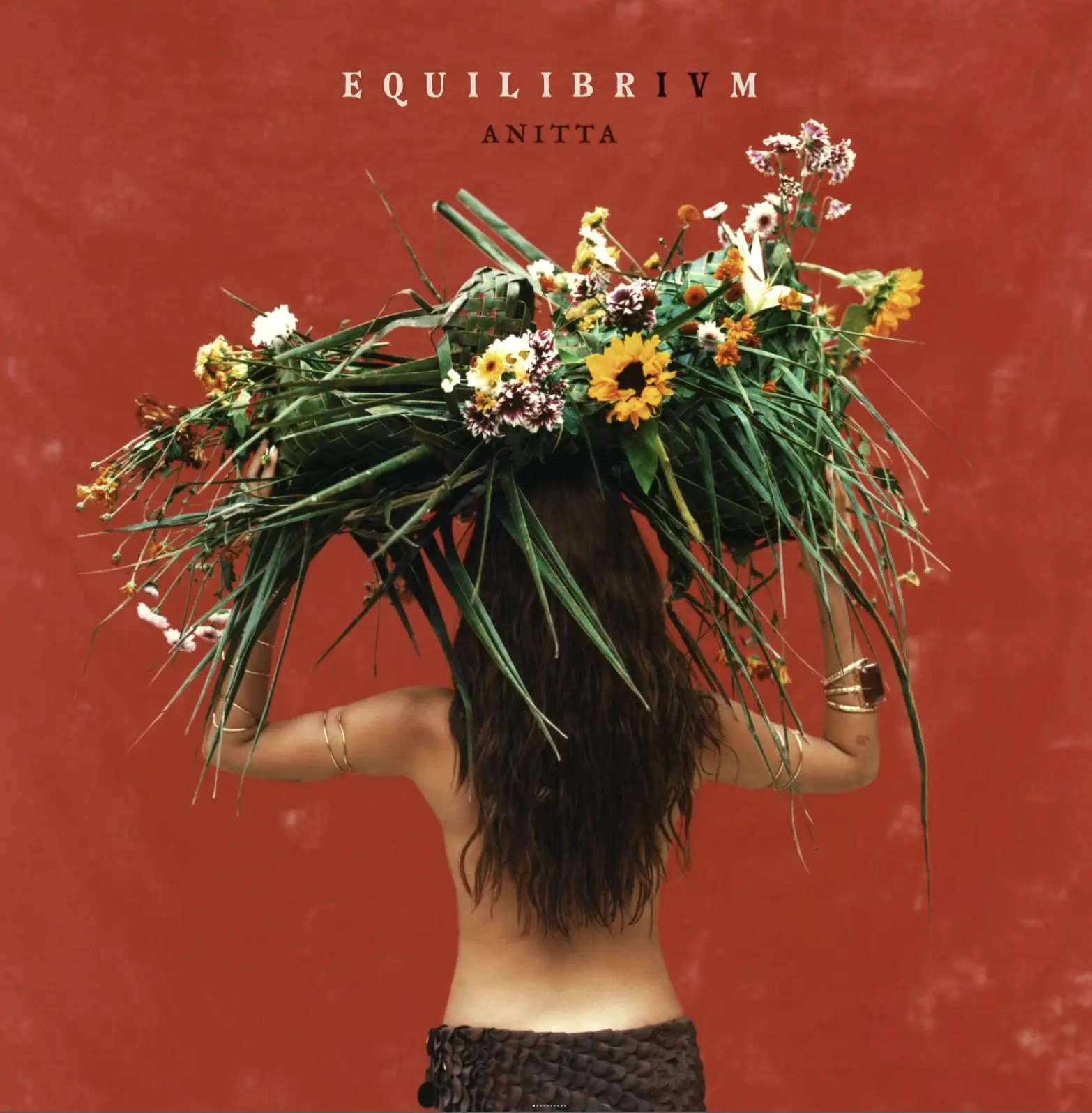
The cover announces the change of atmosphere before the first note: a scarlet backdrop, a profusion of flowers, and long green leaves arranged above Anitta’s head. Her face is turned away. It is a striking editorial image, as much about what the artist chooses to place in the foreground as it is about the artist herself. Inside the record, the sound shifts from the intimacy of a love song to the force of percussion, from familiar pop pleasures to references that carry centuries of Brazilian cultural memory.
The year success stopped being enough
To understand EQUILIBRIVM, we need to go back to 2022, to a moment when Anitta seemed to be getting everything she had spent years working towards. Envolver reached the top of Spotify’s global chart, making her the first solo Latin artist to achieve that distinction. Her international ambitions were becoming reality, bringing with them a punishing routine of commitments in Brazil and abroad. In retrospect, the timing of what happened next is extraordinary: the year that confirmed her commercial power was also the year she began questioning the price she was paying for it.[13]
In interviews published in 2024, Anitta disclosed that she had experienced a period of serious illness following the release of Versions of Me. She described fevers, pain throughout her body, and episodes when she could not walk. Medical investigations explored possible causes, including cancer and autoimmune illness, but the reporting did not establish a definitive diagnosis. The uncertainty itself became part of the experience. Faced with the possibility of losing her ability to work, she began to consider what she would regret if her career ended.[14]
Four years later, speaking on TV Brasil’s Sem Censura, she gave a vivid account of the routine preceding her decision to slow down. She recalled having as little as one day off per month, and spending much of the week travelling or sleeping on aeroplanes. It is revealing to hear that recollection alongside her description of the subsequent creative process. The same artist who had treated every opportunity as something to pursue was beginning to make time for the things that could never appear in a streaming report: rest, her family, and the possibility of an ordinary day.[15]
During this period of introspection, she sought the guidance of therapist Max Tovar, attended retreats, and began writing reflections on her experiences. Her later work drew upon some of that material. She credits the changes she made in her life with improvements in her well-being, and describes spiritual practice as an important part of the journey. These are her accounts of a personal recovery; her illness should not be assigned an unverified diagnosis, nor should her experience be presented as evidence that spiritual practice replaces medical care.
A message from Carmen Miranda
One of the most fascinating threads running through the project is Anitta’s relationship with Carmen Miranda. In an interview on Fantástico, she recalled receiving a biography of the Brazilian performer at a particularly difficult moment. The person who gave her the book urged her to change the ending of that story. Miranda’s international career, the expectations placed upon her, and the personal cost of maintaining a public image offered Anitta an unsettling parallel with her own life. She described taking a retreat after finishing the book, followed by a renewed commitment to caring for herself.[16]
There is something poignant about an artist of Anitta’s generation finding a warning in the history of a woman who died in 1955. Miranda became an international emblem of a version of Brazil packaged for foreign audiences. Decades later, Anitta had to negotiate her own relationship with the demands of global fame, including the expectation that she would continue delivering the kind of entertainment that had made her successful. The Carmen Miranda references in Desgraça, and later in the second volume’s film, take on a different significance when viewed in that context. There is admiration in the homage, alongside a determination to have a different life.
Coming home, and making room for the music
Perhaps the most surprising detail about EQUILIBRIVM is that, for a while, its creator had little interest in making it. The idea had been with her since the early stages of her spiritual journey, yet she had become so disillusioned with the demands of her career that she preferred to remain on an extended break. In a May 2026 interview with Hugo Gloss, she recalled that it was her encounter with creative director Nídia Aranha that revived her enthusiasm for recording an album.[17]
Their collaboration began around a performance for Global Citizen. Impressed by how comfortable the working relationship had been, Aranha encouraged Anitta to return to the songs she had been developing. Anitta already had material, including the eventual collaborations with Shakira and other artists. The sessions at her home grew into a much larger project as they discovered a shared creative direction. Crucially, Aranha asked what the artist actually wanted to say. The answer made room for subjects she had rarely been able to explore across an entire record, including her religious life and the possibility of ending a pop album with a mantra.[17]
When Anitta began developing EQUILIBRIVM, she had already spent years navigating an international career. The album’s creative process brought her back into an intimate domestic environment: much of the recording took place at her Rio de Janeiro home. Songwriters, producers, and performers came together there as she reconsidered her relationship with work, health, and the people closest to her. In interviews surrounding the release, she connected the music with a broader process of personal healing.[5][12]
Creative director Nídia Aranha helped shape an aesthetic in which Brazilian cultural references could inform the entire production. The collaborative sessions brought a particularly strong group of women songwriters into the project. That creative decision is worth noticing in a record so concerned with women’s agency, desire, and self-determination.[6]
Musically, the first volume moves across samba, MPB, bossa nova, axé, funk carioca, reggae, and other contemporary influences. Liniker, Luedji Luna, Marina Sena, Melly, Rincon Sapiência, King Saints, and Shakira are among its collaborators. The pleasure is in hearing these distinct voices inhabit the same musical world. The record makes space for romantic vulnerability, the dance floor, and spiritual reflection without demanding that one experience cancel out the others.[7][5]
The album she wanted to make
The distinction between making an album for oneself and making an album for an audience can be misleading. Anitta still wanted listeners to find something meaningful in these songs; the difference was the degree of authority she was prepared to give the market over her decisions. As early as 2024 she had spoken about the pressure of measuring her achievements through chart positions. By the time she was assembling EQUILIBRIVM, there was room for a different measure of success: the ability to produce music she enjoyed, and to maintain a life in which she enjoyed making it.[13][14]
That freedom came at a financial cost. In May, POPline reported accounts from members of the audiovisual team describing tight budgets, production challenges, and resistance from the international label to a project it considered commercially risky. According to that reporting, Anitta used her own resources through Floresta Records to bring her vision to life. The artist herself said at the album launch that this was her most expensive record to make, without disclosing the amount. The exact financial arrangement has not been independently established, but her own description makes clear she was willing to invest substantially in it.[21]
It is important to keep the commercial reality in view. EQUILIBRIVM was released through a major-label arrangement, featured internationally recognised artists, and had a deliberate promotional campaign. Anitta’s decision concerned creative priorities rather than an absence of professional ambition. Indeed, the conversations surrounding her first Latin Grammy suggest she was particularly interested in an album’s emotional afterlife: what people might take from it after the novelty of release week had passed.
For an artist operating at her scale, this is an unusual proposition. We have become accustomed to campaigns in which the performance of each single is evaluated within hours, in which a listener skipping a song can change the direction of a release strategy. Listening to EQUILIBRIVM in sequence asks something different of us. The album has an emotional architecture, and some of its most interesting ideas become apparent only when we consider what happens between its opening and closing tracks.
When faith becomes impossible to overlook
Anitta has publicly identified herself as a daughter of Logun Edé, an Orixá worshipped in Candomblé. The relationship is part of her life beyond this album: she co-wrote the samba-enredo selected by Unidos da Tijuca for its 2025 Carnival tribute to Logun Edé. In 2024, her video for Aceita had already made her religious practice visible to a vast audience, prompting a loss of followers and renewed discussion about prejudice against Afro-Brazilian faiths.[3][4]
That history makes the visual ambition of EQUILIBRIVM all the more compelling. Here, an internationally recognised artist gives cultural references frequently marginalised or misunderstood a central place in her work. Aranha told Billboard Brasil that the team approached its visual vocabulary through study and consultation, conscious of the responsibility that comes with representing traditions affected by religious intolerance.[6]
The followers who left — and the ones who arrived
In May 2024, the promotion of Aceita, from Funk Generation, had already demonstrated how differently the public could respond to Anitta’s expression of faith. She had published images of her religious life, and the video showed Candomblé rituals. The Associated Press reported her account of losing approximately 200,000 Instagram followers; in a subsequent interview covered by CNN Brasil, she recalled the total reaching around 300,000. These were figures she reported at different points, not separate losses that should be added together.[3][20]
Her response in 2024 is especially relevant to the album she would release two years later. She spoke about preferring an audience with whom she could share her values, even if that meant performing in front of fewer people. Her religious connection, she explained, reached back to childhood through her father, Mauro. The expression of that connection was part of her identity long before it became the subject of international entertainment news.[19]
The reception of EQUILIBRIVM produced a second episode. After performing Meia-Noite on the Brazilian television show Domingão com Huck, Anitta said she lost around 100,000 followers during the album’s release week. In her May interview, however, she described what happened next: about a week after the launch, she had gained roughly twice as many followers. She was also hearing from people who had known of her for years without ever having listened to one of her albums.[17]
200,000–300,000
Followers lost, according to Anitta’s accounts at different stages of the backlash.
~100,000
Followers lost during release week, in her account of the response to Meia-Noite.
~200,000
Followers gained shortly afterwards, based on her description of gaining about twice the number she had lost. These are artist-reported estimates, rather than independently audited platform statistics.
The figures make for a compelling headline, but treating the episode simply as a marketing triumph would miss much of its meaning. For followers of religions that are frequently subjected to prejudice, seeing an artist with Anitta’s reach express her beliefs without apology can matter in ways that are difficult to capture through social media statistics. Equally, people unfamiliar with the traditions were now encountering their cultural expressions in songs they could play at home, at parties, or on their way to work.
In August, Anitta told Pedro Bial that messages from listeners, including those confronting discrimination and those experiencing personal distress, had helped convince her to deepen the project. There is a difference between an artist speaking about her own faith and expecting the people who hear her music to share it. The album’s invitation is broad enough to include listeners of different beliefs, or none, who recognise something of their own experience in what she has made.[18]
Aranha describes the album’s conceptual progression as resembling a gira, a gathering associated especially with Umbanda. Each song contributes a different emotional or spiritual energy to the whole. It is an intriguing way of understanding why a record capable of moving between flamboyant dance music and tenderness feels coherent. A pop album can borrow a structural idea from spiritual practice while remaining a work of artistic expression.[6]
The songs that carry religious references
There are fifteen tracks on the original release. Our series will concentrate on the songs most directly connected to Orixás and Afro-Brazilian spiritual entities, leaving the other tracks within the wider musical discussion. Here are five starting points, each of which will receive its own article.
Desgraça
A Carmen Miranda-inspired opening changes into a powerful contemporary celebration drawing on the imagery of Pombagira and crossroads.
Mandinga
A sample of Baden Powell and Vinicius de Moraes’s Canto de Ossanha accompanies a transition from seduction to autonomy with Marina Sena.
Ternura
Melly joins Anitta on this gentle composition; a handpan evokes flowing water, an intentional sonic association with Oxum.
É de Nanã
Rincon Sapiência and King Saints join a track that draws on Os Tincoãs’ Cordeiro de Nanã and honours the creative power of the divine feminine.
Meia-Noite
With Los Brasileros, Anitta adopts a first-person perspective inspired by Pombagira, bringing her into the forceful musical vocabulary of funk carioca.
Musical credits and the artist’s explanations: official album notes and releases. [5][8][9][10]
Other tracks widen the project’s frame. Bemba, for example, celebrates Afro-Brazilian cultural inheritance through Bahia, while Ouro incorporates a Buddhist reference. Such moments matter because they prevent an overly simple reading of the album as a single religious statement. Anitta is exploring the coexistence of traditions, feelings, and musical languages.[5][10]
Fifteen songs, from Desgraça to Ouro
One reason I recommend playing the album in its intended order is Anitta’s own explanation of the title of its opening track. In her interview with Hugo Gloss, she described an arc of energetic cleansing that begins with Desgraça (misfortune) and ends with Ouro (gold). Some listeners reacted negatively to the opening title, even though the contrast was an essential part of her idea. The titles alone suggest the journey from a difficult emotional state to a place of greater clarity.[17]
Mandinga follows with a remarkably different musical proposition, its two-part structure using Marina Sena’s intervention to alter the perspective of the song. Caminhador, with Liniker, introduces perseverance; Deus Existe, with Ponto de Equilíbrio, addresses spirituality through reggae. Meanwhile, the dance-oriented Choka Choka and the nocturnal energy of Meia-Noite retain the pleasure of movement that has always been central to Anitta’s work. The closing mantra, Ouro, gives the listener time to reflect on the experience. It is a remarkably expansive understanding of what equilibrium can contain.[5]
The continuity with her earlier music matters here. Anitta rejected the suggestion, during her conversation with Bial, that a more reflective record implied a judgement against the funk that helped establish her career. She spoke in defence of music made for dancing and the people whose lived experiences it expresses. A work like EQUILIBRIVM should therefore be heard alongside her earlier catalogue, with all the contradictions and continuities that make an artist interesting.[18]
Four acts: the visual language of EQUILIBRIVM
The first album’s major audiovisual sequence unfolds over four releases. Producer Felipe Britto and creative director Nídia Aranha conceived the acts as parts of a connected story, with image, sound, choreography, and Brazilian cultural references reinforcing one another. It is worth watching in order; each chapter introduces a new visual atmosphere while carrying the themes of the previous one forward.[8][11]
Despacho
Desgraça · Heartbreak, offerings, and a passage into the album’s symbolic universe.
Watch on Anitta’s official YouTube channel ↗Fé e Festa
Meia-Noite · Drums, funk, fire, and choreography informed by Pombagira and Brazilian dance traditions.
Watch on Anitta’s official YouTube channel ↗Deus Mãe
Mandinga and Nanã · Enchantment, feminine self-determination, and the imagery of creation.
Watch on Anitta’s official YouTube channel ↗Renascimento
Ternura, Bemba and Caminhador · Water, Bahia’s cultural heritage, and renewal.
Watch on Anitta’s official YouTube channel ↗In the second act, a circle of atabaques surrounds an imposing sound system; clay vessels and flames help establish a nocturnal atmosphere. The visual references connect the energy of contemporary funk to inherited practices and forms of movement. The final act changes the register, moving towards water, memory, and the pleasure of collective celebration. Neither requires us to mistake a staged music video for a literal recording of a religious ceremony.[8][10]
Each of these films deserves a closer reading, and the second volume of EQUILIBRIVM will take us further into Anitta’s audiovisual universe. We will give the longer film its own article rather than trying to explain every scene here.
From a television backlash to the Latin Grammy stage
Seven months after the release week during which she had lost followers, Anitta performed on the main stage of the 27th Latin Grammy Awards in Las Vegas. Her medley began with Ternura, moved through Desgraça and Choka Choka, and concluded with Meia-Noite. The inclusion of that final song gives the performance a particularly striking significance in the story of the record: this was the same composition she had associated with the April backlash.[23]
Shortly afterwards, the prize for Best Portuguese Language Contemporary Pop Album became the first Latin Grammy of her career. EQUILIBRIVM had also been nominated for Album of the Year, a category ultimately won by Rosalía. Anitta used her acceptance speech to remind the audience that Brazil belongs fully within Latin America, despite its different national language, and to call for greater recognition of Brazilian musicians within the wider Latin music industry.[24][26]
In her statement following the ceremony, she celebrated the appearance of Orixás, Exus, and Pombagiras on the Grammy stage, and thanked those who had contributed to her spiritual and artistic journey. She also spoke about the difficulty of promoting a reflective work within an attention economy dominated by algorithms, sensationalism, and the appetite for constant novelty. Her comments return us to the central question of EQUILIBRIVM: can an artist retain control over the purpose of her work, even while operating inside an industry that rewards numbers above almost everything else?[22]
The recognition has continued with the 2027 Grammy nomination in the Best Global Music Album category. There is a satisfying irony in seeing the artist’s turn towards Brazil bring fresh international interest in her work. That reception also helps explain why she felt there was more to explore, and why the second part of EQUILIBRIVM ultimately became an even more ambitious creative undertaking. We will return to that decision, and to the film she wrote herself, in the next instalment of Rebel Notes.[25][27]
Why this album belongs in Rebel Notes
Many of the songs from Anitta’s EQUILIBRIVM project accompanied the creation of my novel The Chosen. In its fictional world, Afro-Brazilian spiritual traditions and the Orixás have a significant presence. The music gave me another way of engaging with that cultural landscape, and it is one of the reasons I wanted to begin this series.
As an author, I am interested in the way an artistic medium can introduce us to another. A song can lead to a question about a religious reference; that question can lead to the history of a tradition, or to another work of music, art, or literature. Rebel Notes will explore the albums, songs, and films; my author website, Lupe Farkas, remains a separate home for the research behind my fiction.
The novel, of course, is fiction. Anitta’s work and the communities whose cultural heritage it references exist independently of it. That distinction will remain clear throughout our series.
Where we go from here: the EQUILIBRIVM series
Rebels, this is only the beginning. In our next feature, we will continue our journey with EQUILIBRIVM II, exploring the second album, the circumstances that led Anitta to create it, and the musical and spiritual ideas that connect the two records.
Our forthcoming Rebel Notes features will each be dedicated to one of the songs from the two albums that draws on the Orixás, Pombagiras, Exus, or other Afro-Brazilian spiritual traditions. We will explore the meaning behind the lyrics, the musical influences, the symbolism in the official videos, and the references that can easily escape a listener unfamiliar with Brazilian culture. We will also dedicate separate features to the audiovisual chapters and the ambitious long-form film accompanying EQUILIBRIVM II.
For those who want to go deeper into the religions themselves, the related research on my author website is linked below. Follow Imperfect Rebel for the next chapter in our editorial series.
Related reading on Lupe Farkas · The Chosen
- Exu, Ogun and Nossa Senhora Aparecida — the religious foundations behind Chapter Five.
- Terreiros, Orixás and survival — the historical and cultural background.
- The Chosen dictionary — words and expressions from the novel.
Sources & further reading
- Latin Recording Academy — 2026 winners and nominees
- Agência Brasil — Grammy nomination and album release dates, 17 November 2026
- Associated Press — the 2024 backlash against Aceita
- Associated Press — Anitta, Logun Edé and the 2025 Carnival tribute
- Universal Music Brasil — official album notes, artist commentary and credits
- Billboard Brasil — interview with creative director Nídia Aranha, 20 May 2026
- Apple Music — EQUILIBRIVM, album information and musical context
- Universal Music Brasil — Fé e Festa and the four-act release calendar
- Universal Music Brasil — Deus Mãe, Mandinga and Nanã
- Universal Music Brasil — Renascimento, Oxum and the closing act
- CNN Brasil — behind the audiovisual production
- Associated Press — interview with Anitta, 15 April 2026
- Rolling Stone — Anitta on her 2022 health crisis, chart pressure and return to funk (2024)
- People — Anitta’s account of her illness and changing priorities, 2 May 2024
- Agência Brasil / TV Brasil — Sem Censura interview on faith, health and exhaustion, 12 August 2026
- CNN Brasil — Fantástico interview on Carmen Miranda, illness and recovery
- Hugo Gloss — interview on the album’s origins, follower losses and audience response, 5 May 2026
- Gshow — Conversa com Bial, 26 August 2026
- Billboard Brasil — Anitta’s response to religious intolerance, 13 May 2024
- CNN Brasil — Anitta recalls losing 300,000 followers over Aceita (2024)
- POPline — reported financing disagreements and Anitta’s own investment, 21 May 2026
- Gshow — Anitta’s statement following her Latin Grammy win, 13 November 2026
- Billboard Brasil — EQUILIBRIVM on the Latin Grammy stage, November 2026
- UOL — Anitta’s acceptance speech and appeal for Brazilian representation, 13 November 2026
- Billboard Brasil — the response to volume one and the origins of volume two, 24 July 2026
- Latin Recording Academy — official 2026 nominations
- Recording Academy — official Grammy nomination history
Independent editorial coverage. This article is not affiliated with or endorsed by Anitta, her label, or the religious communities discussed. Official album artwork and music videos belong to their respective rights holders.
[…] aprile 2026 · Uscita in Brasile15 braniLatin Grammy · 12 novembre 2026 Leggi questo articolo in:English · Italiano · Português (Brasil) La crisi di saluteL’albumLibertà artisticaFede e […]