
AI Writing Competitions 2026–2027: Inside France’s Prix Pascal and the Future of Literature
AI Writing Competitions 2026–2027: Inside France’s Prix Pascal and the Future of Literature
France has launched a literary competition where artificial intelligence is compulsory. Other international awards are following a similar path. Is literature entering an entirely new era?
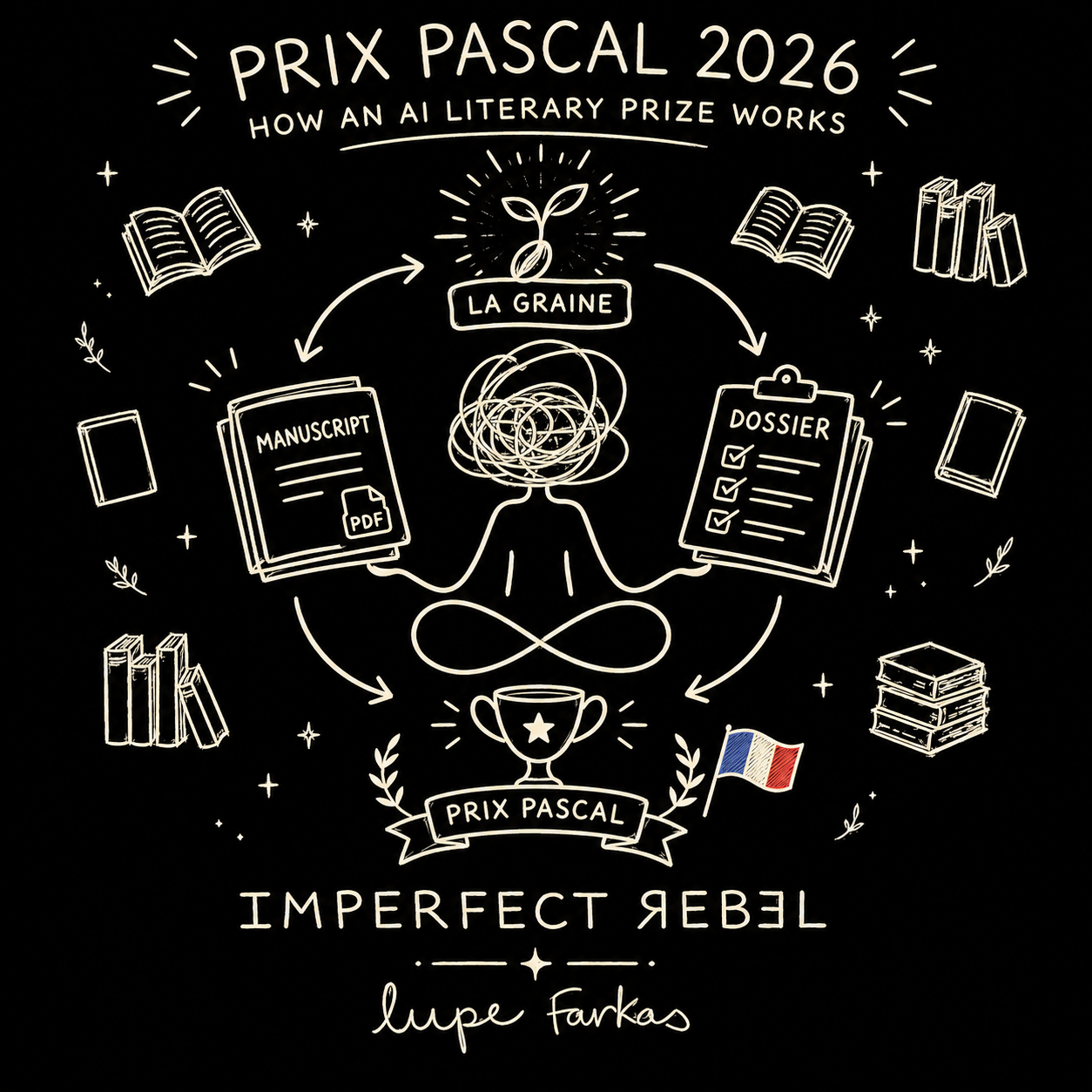
REBELS!!! Imagine winning a literary prize for a book written with ChatGPT. A few years ago, that sentence would have sounded like the premise of a particularly strange science fiction novel. Today, there are literary competitions specifically designed to reward works created with artificial intelligence.
The Prix Pascal, a new French literary award, is accepting submissions until 30 November 2026. Meanwhile, other international competitions are preparing to recognise AI-assisted authorship in English, creating a new territory within the literary world.
Whether you find the prospect fascinating, terrifying, or somewhere between the two, something genuinely interesting is happening. Artificial intelligence is acquiring its own place within literary competitions, and the implications deserve a proper conversation.
What is the Prix Pascal?
Named after the seventeenth-century French mathematician, philosopher, writer, and inventor Blaise Pascal, the Prix Pascal de Littérature IA rewards literary works created through collaboration between humans and artificial intelligence.
The competition invites authors to experiment with technology and address ecological, social, and ethical challenges. Its manifesto emphasises creative originality, new methods, cultural inclusion, and the study of human–AI collaboration through annual editions. The organisers seek works whose creative conception offers something distinctive and meaningful to the reader.
Who can enter the Prix Pascal 2026?
The competition welcomes international applicants without nationality or residency restrictions. The manuscript must be in French. Both fiction and nonfiction can qualify, and self-published works are accepted; books already issued by traditional publishers are excluded. Each candidate may submit up to three entries. Authors must explain which AI tools they used and how.
How to apply for the Prix Pascal: a step-by-step guide
The application requires three components, submitted together through the official online form.
Step 1: La Graine — the creative seed
The first element is your original creative intention, limited to 4,000 characters in the online form. Explain what inspired the project, what you wanted to investigate, and how artificial intelligence shaped its development.
This is an opportunity to communicate the thinking behind your creation. What did you want to achieve, and why did you choose this particular creative method? A synopsis may tell the reader what happens in a book; the seed can explain why the book needed to exist. The organisers say that only the winner’s seed may be made public, with the author’s consent.
Step 2: Prepare your manuscript
Aim for approximately 300,000 characters, including spaces. Prepare a French-language PDF with readable typography, 1.5 line spacing, standard margins, and pagination or a table of contents. Include the title, an optional subtitle, and a back-cover description. The manuscript must be anonymous: remove the author’s name from the document.
As an additional precaution, check the identifying information stored in your PDF’s document properties before uploading it.
Step 3: Create your technical dossier
Here is where the competition becomes particularly interesting. Prepare a separate PDF of no more than two pages to document the tools, prompts, and methods involved in producing the work. The organisers want sufficient detail for others to reproduce or adapt the method; including source code is optional.
Think about how you established your creative constraints, evaluated the machine’s suggestions, corrected mistakes, and managed the coherence of the finished book. A technical dossier is an opportunity to explain how decisions were made instead of merely naming the software.
Step 4: Submit your application
Complete the application with your name, email address, optional telephone number, creative seed, and both PDFs. The manuscript and dossier together must not exceed 20 MB. Confirm the required declarations about AI assistance, the accuracy of the dossier, and the absence of manually inserted pre-existing third-party human-authored text. Read and accept the official regulations before submitting. Keep your submission confirmation and any reference number for your records.
- French-language anonymous manuscript (PDF).
- Creative seed: maximum 4,000 characters.
- Technical dossier: maximum two pages (PDF).
- Combined PDFs: maximum 20 MB.
- Deadline: 30 November 2026, 23:59 Paris time.
Prix Pascal 2026: important dates and prize
The dates above follow the current official website calendar; the PDF regulations contain an earlier schedule for the final stages. Check the live calendar for updates. The prize offers publication of the winning work and media visibility; no monetary award is specified in the current regulations.
The competition states that the manuscript and technical dossier remain the candidate’s property. This does not settle the broader copyright questions associated with machine-generated text.
Can artificial intelligence democratise literature?
Among the objectives described in the Prix Pascal manifesto, cultural inclusion is particularly compelling. Having an extraordinary imagination does not automatically mean possessing the technical ability to produce a sophisticated literary manuscript. Disabilities, dyslexia, linguistic barriers, and unequal access to education can all affect how someone expresses their ideas.
Artificial intelligence could offer some of those individuals an opportunity to communicate stories that might otherwise remain untold. The possibility of writing in another language is equally fascinating. Imagine having an idea for a novel and being able to develop it in a language you have never mastered, reaching readers you might otherwise have been unable to reach.
Technology has the potential to open doors. What people choose to do once those doors are open is another conversation entirely.
Can AI judge literature?
Interestingly, the Prix Pascal organisers have rejected the idea of appointing artificial intelligence to judge the competition. In an article published on 11 November 2026, they explained their reservations about automated literary judgement, particularly its ability to recognise originality and the importance of human judgement and accountability.
A machine can generate a convincing description of heartbreak, but it has never had its heart broken. It can describe grief with remarkable linguistic precision, without ever having experienced the loss of someone it loved. The reader brings those experiences to the page, and that relationship between language and lived experience is one of the most fascinating aspects of the entire experiment.
Writing a book with AI: is it really that easy?
If Instagram is to be believed, anyone can generate a bestselling novel before breakfast, establish a publishing empire by lunchtime, and retire comfortably before Christmas. Usually, there is a course available for purchase somewhere underneath the video.
The reality is considerably more complicated. Artificial intelligence can produce enormous quantities of text, but creating a coherent manuscript requires direction, consistency, revision, judgement, and an understanding of what makes a story work. Generating words is only one part of creating a book. Selling that book is an entirely different challenge, as independent authors know painfully well.
There are also legitimate questions surrounding copyright, the material used to train language models, consent, transparency, and the economic consequences for professional writers. Experimenting with technology does not require pretending those concerns do not exist.
The Prix Pascal offers something useful to this conversation: an opportunity to examine actual literary works and their creative processes, rather than relying entirely on promises and predictions. That is, of course, if the relevant information is eventually made available.
Should Imperfect Rebel participate in AI literary competitions?
Well, Rebels, when it comes to my own novels, the answer is no.
I love writing far too much, and I am certainly not giving that pleasure to artificial intelligence.
I love discovering where my characters take me, arguing with them inside my own head, losing track of time while writing a chapter, and occasionally wondering whether the multitude of voices living inside my imagination should be contributing towards the household expenses.
Writing is one of the greatest pleasures of my life. Why would I outsource the very thing I enjoy doing? Those who follow Imperfect Rebel already know how fascinated I am by technology. I embrace AI as a tool, enjoy exploring its creative possibilities, and believe there is considerable value in understanding what it can and cannot accomplish.
I can appreciate what someone else creates through artificial intelligence while choosing to write my own stories myself. There is room for both approaches, provided we remain transparent about how our work was created. I want to know what happens when artificial intelligence helps someone write a prizewinning novel. I also want to keep the pleasure of writing mine.
Other AI writing competitions to enter in 2026 and 2027
Now, if you are a Rebel who would like to participate in an AI literary competition besides the Prix Pascal, here are four international awards worth investigating. One has already closed its current edition, but is worth watching for next year.
The Prompty Awards — United States
English-language fiction, including qualifying translations. At least half of the final prose must be AI-generated. Six categories cover literary fiction, science fiction, thriller and mystery, speculative fiction, romance, and historical fiction.
- Deadline: 31 December 2026.
- Fee: US$40; minimum length: 10,000 words.
- Grand prize: US$1,000 and optional publication agreement.
- Results: 1 April 2027.
The In Silico Awards
Fiction produced with AI involvement, in English or translation. There is no fixed minimum proportion of machine-generated prose. The proposed competition requires a human author to direct, review, and take responsibility for the work, and to document the creative process.
- Planned opening: 1 December 2026.
- Planned deadline: 1 February 2027.
- Fees: US$45 for short fiction; US$125 for longform fiction.
- Maximum length: 180,000 words.
MIELOGOS Literary Prize
This competition recognises what it calls symbiotic authorship, involving substantive human–AI collaboration. Its founding cycle is international and accepts English review versions of qualifying work. The work must have reached a real public audience between 1 January 2024 and 31 December 2026.
- Opens: 1 February 2027.
- Deadline: 31 May 2027, 23:59 UTC.
- Fee: free; maximum two entries per entrant.
- Winner announcement: 1 December 2027.
Nikkei Hoshi Shinichi Literary Award — Japan
This established Japanese award has accepted contributions involving artificial intelligence since its first edition. Its fourteenth cycle closed on 6 October 2026, receiving 2,725 submissions across the general and junior divisions. The current rules specify unpublished Japanese-language manuscripts and a contactable representative for non-human entrants.
AI literary awards at a glance
| Competition | Next deadline | Entry fee |
|---|---|---|
| Prix Pascal | 30 Nov 2026 | Check rules |
| Prompty Awards | 31 Dec 2026 | US$40 |
| In Silico Awards | 1 Feb 2027 (planned) | From US$45 |
| MIELOGOS | 31 May 2027 | Free |
| Hoshi Shinichi Award | Next cycle TBA | Check next cycle |
Several of these contests are new. Read the organisers’ rules, copyright provisions, agreements, and fee conditions before entering. Inclusion in this guide is not an endorsement or guarantee of the competition’s reputation.
Would you read a book written by artificial intelligence?
That is the question I am leaving you with today, Rebels. If a novel made you laugh, cry, lose sleep, or question everything you believed, would discovering afterwards that artificial intelligence helped create it change your opinion of the book?
More importantly, would you give artificial intelligence the opportunity to move you in the first place? I will be following the Prix Pascal throughout December and continuing our investigation into the evolving relationship between literature and technology.
With love from my wolfy heart,
Lupe Farkas
Your Imperfect Rebel
Official sources and competition links
- Prix Pascal — official website and calendar
- Prix Pascal — application form
- Prix Pascal — manifesto
- Prix Pascal — regulations (PDF)
- Prix Pascal — resources
- Prix Pascal — why the jury remains human
- Prompty Awards — official rules
- In Silico Awards — draft rules
- MIELOGOS — eligibility
- Nikkei Hoshi Shinichi Literary Award — official site
Competition information checked 20 November 2026. This guide will be updated as the organisers publish new information.

[…] Read our Prix Pascal investigation […]