Readers Fall in Love With Genres. The Authors Who Keep Writing Give Them Somewhere to Go.
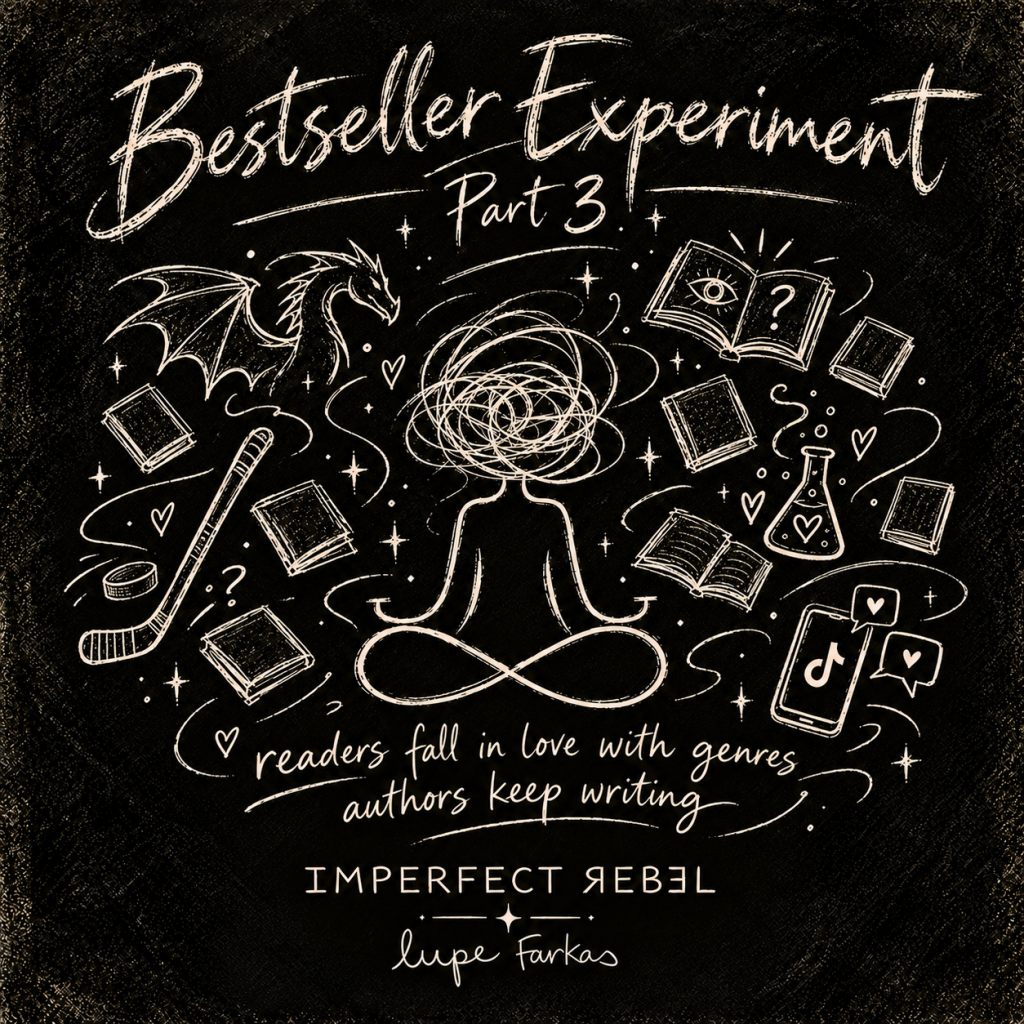
Readers Fall in Love With Genres. The Authors Who Keep Writing Give Them Somewhere to Go.
Dragons, hockey players, scientists in love, psychological thrillers and the extraordinary readers who turn books into international phenomena. Plus, a special tribute to Sophie Kinsella.
HIIII REBƎLS!!!
WE HAVE REACHED THE END OF THE BESTSELLER EXPERIMENT!
Well, theoretically. Because after investigating Freida McFadden’s 90 million book sales and spending an absolutely unreasonable amount of time examining the publishing careers of Stephen King, Nora Roberts, Sarah J. Maas, Colleen Hoover and several other bestselling authors, I discovered something that sent me into an entirely different research rabbit hole.
THE READERS!
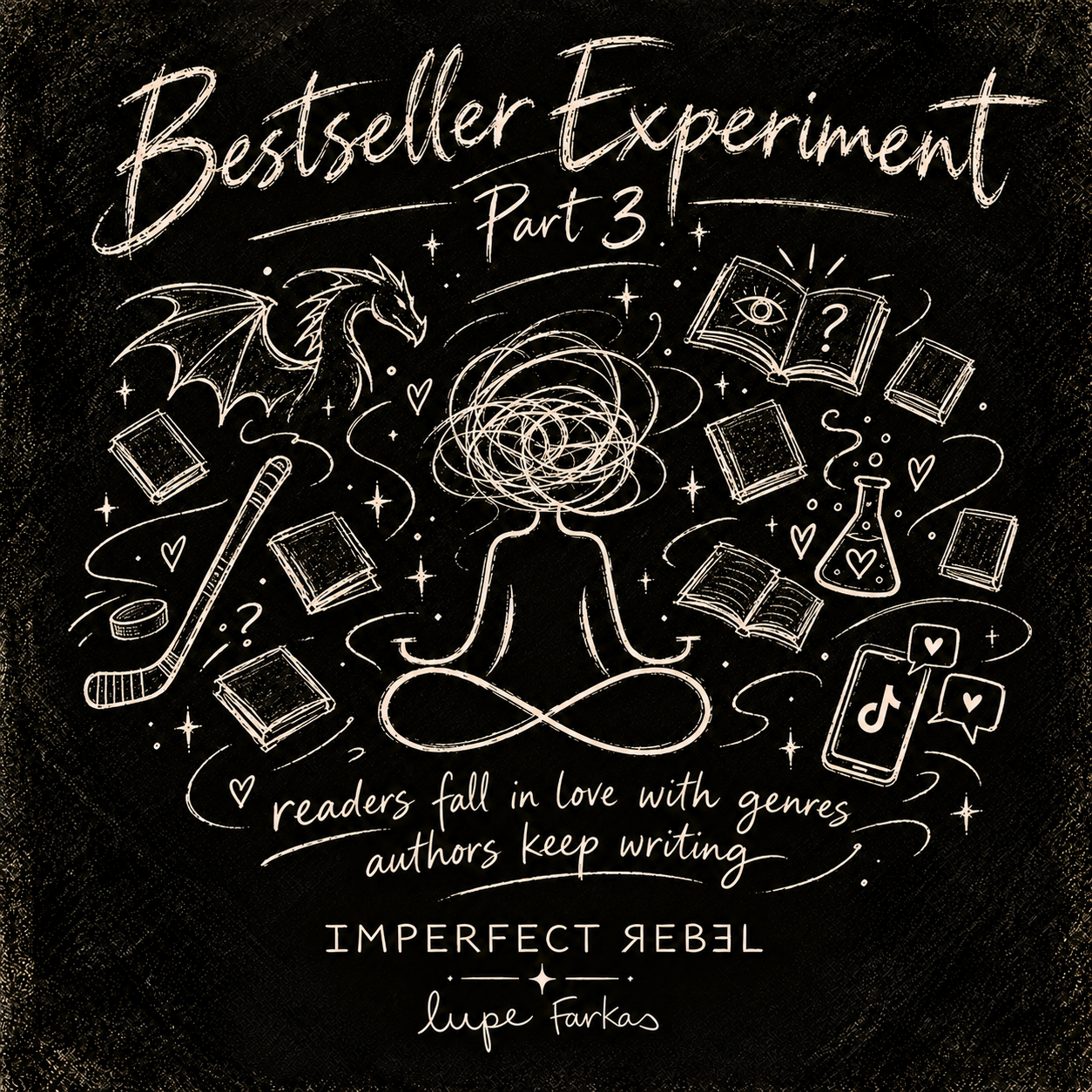
While I was busy counting novels, comparing publication dates and investigating authors who apparently write faster than I can organise my notebooks, millions of readers were falling in love with fictional hockey players, dragon riders, morally questionable faeries and scientists who seem considerably more interested in kissing than completing their research projects.
Psychological thriller readers were enthusiastically recommending books that had completely deceived them. Horror readers were exploring increasingly unsettling fictional worlds, while BookTok communities were discovering older novels and transforming them into international sensations years after their original publication.
Suddenly, I had another question. What happens when readers become obsessed with a particular genre? How does a romance about hockey players become an international phenomenon? When did scientists become romantic heroes? Why are millions of people emotionally invested in faeries and dragons?
Naturally, I went investigating.
My manuscript has officially filed a complaint.
FIFTY MILLION BOOKS. EXCUSE ME?!
Let’s begin with a rather extraordinary number.
In March 2026, TikTok published research conducted with NielsenIQ BookData and Media Control showing that more than 50 million books recommended by the BookTok community were sold across European markets during 2025, generating approximately €800 million in revenue.
FIFTY MILLION BOOKS! EIGHT HUNDRED MILLION EUROS!
Apparently, readers discussing books on their phones have become a rather significant part of the publishing industry.
What fascinates me is how dramatically the process of discovering books has changed. For decades, readers relied on bookshops, libraries, newspaper reviews, literary magazines and recommendations from people whose taste they trusted. Those things still exist, of course, but today somebody can publish a thirty-second video explaining how completely devastated they were by a novel, and thousands of people immediately want to experience exactly the same emotional destruction.
Honestly, that might be the most accurate description of readers I’ve ever encountered.
We discover a wonderful book, suffer tremendously, cry into a pillow, question every decision made by the characters and immediately recommend it to somebody we love. Apparently, sharing emotional damage is a literary tradition.
But the really interesting discovery came when I began investigating which genres were attracting all this enthusiasm.
ROMANTASY: THE FAERIES HAVE TAKEN OVER
Let’s begin with the dragons, the faeries and the dangerously attractive supernatural men who apparently have better wings than communication skills.
SARAH J. MAAS, I’M LOOKING IN YOUR DIRECTION!
Romantasy, the increasingly popular combination of fantasy and romance, has developed an extraordinarily enthusiastic readership. Sarah J. Maas built enormous fictional worlds through Throne of Glass, A Court of Thorns and Roses and Crescent City, while Rebecca Yarros introduced readers to Basgiath War College in Fourth Wing, followed by Iron Flame and Onyx Storm.
Suddenly, millions of readers were discussing dragons, magical abilities, enemies-to-lovers relationships and fictional characters as though they were members of their immediate families. Some of those discussions are impressively intense. People debate romantic pairings, hidden clues, character motivations and future storylines with an enthusiasm that would make an international investigative committee proud.
According to Circana BookScan, romantasy was among the fastest-growing subjects within American romance publishing during the first part of 2025, recording triple-digit year-on-year print-sales growth.
But the part I find most fascinating happens after a reader finishes a book they adore.
Someone discovers Fourth Wing and starts looking for more dragon riders. Another reader finishes A Court of Thorns and Roses and begins hunting for stories involving faeries, dangerous magical worlds and complicated romantic relationships. Somebody becomes hopelessly attached to a morally questionable character and immediately wants another fictional man with equally suspicious decision-making abilities.
The search begins with a particular author, but it can quickly become a search for an entire kind of emotional experience.
A reader falls in love with one book and discovers a whole genre waiting to be explored.
The wonderful thing is that authors have been writing romantic fantasy for decades. What we’re witnessing is a remarkable period of visibility for stories that combine immersive fantasy worlds with powerful romantic relationships.
Apparently, sometimes the doorway into an entirely new reading obsession comes with wings.
HOCKEY ROMANCE: WHEN DID EVERYBODY BECOME AN ICE HOCKEY EXPERT?
Now THIS investigation made me laugh.
Because somewhere along the way, an impressive number of people developed a passionate interest in ice hockey. Well, a very particular kind of hockey. The kind involving attractive athletes, romantic complications, impressive shoulders and occasionally very little clothing. Purely literary research, obviously.
Elle Kennedy published The Deal, the first novel in her Off-Campus series, in 2015. Rachel Reid’s Heated Rivalry appeared in 2019, while Hannah Grace’s Icebreaker became another enormous name in hockey romance after its publication in 2023.
Different authors, different romantic dynamics and different fictional universes, all connected by a sporting environment readers apparently cannot get enough of.
Then came the television adaptation of Heated Rivalry, which premiered in late 2025.
REBƎLS, LOOK AT THESE NUMBERS!
According to Publishers Weekly, citing Circana BookScan figures, weekly American print sales of Heated Rivalry increased by more than 8,000% between the week beginning 30 November 2025 and the week ending 17 January 2026. During that measured period, sales of the wider Game Changers series increased by nearly 4,000%, with approximately 206,000 copies sold.
MORE THAN EIGHT THOUSAND PERCENT!
I looked at those numbers twice. Then a third time, because there’s something particularly fascinating about this story: Heated Rivalry had been available for years before the television adaptation introduced it to a much larger audience.
The books were already there. The characters existed. The stories had readers who loved them. Then the adaptation arrived, and suddenly an extraordinary number of people wanted to discover what happened between Shane Hollander and Ilya Rozanov.
The renewed interest also reached other hockey-romance authors. Publishers Weekly reported increased sales for Elle Kennedy’s Off-Campus series following the success of the programme.
What interests me most is the journey from one story to an entire category. A reader discovers Heated Rivalry, then searches for other hockey romances. Another finds Icebreaker and starts exploring sports romance. Someone discovers The Deal and suddenly has several interconnected books waiting to be read.
Honestly, if somebody had told me ten years ago that ice hockey would become one of the hottest subjects in romantic fiction, I would have asked whether they were feeling all right. Today, I’d ask for their book recommendations.
STEM ROMANCE: THE SCIENTISTS ARE KISSING!
Now we need to talk about Ali Hazelwood.
A neuroscientist who writes romantic fiction featuring scientists. I LOVE THIS CONCEPT!
The Love Hypothesis appeared in 2021, introducing readers to Olive Smith, a PhD candidate whose fake-dating arrangement with a professor becomes increasingly complicated. Love on the Brain followed in 2022, while Love, Theoretically arrived in 2023 with a romance involving rival physicists.
RIVAL PHYSICISTS!
I spent years working around engineers, technical specialists and people capable of having extremely passionate disagreements about measurements, processes and procedures. Believe me, I’ve witnessed some spectacular arguments concerning technical specifications.
It had never occurred to me that laboratories and academic research could become such entertaining settings for romantic fiction. Apparently, Ali Hazelwood looked at the scientific world and decided it needed more kissing. Excellent decision.
What makes STEM romance interesting is how it combines familiar romantic dynamics with a distinctive professional environment. Fake dating, academic rivalry, workplace tension and complicated relationships acquire an entirely different flavour when the characters are working in laboratories, competing for research opportunities or arguing about physics.
The romantic story remains central, but the professional setting gives readers another fascinating world to explore. Intelligent, ambitious female characters navigate demanding careers while discovering that relationships can be considerably more complicated than scientific experiments.
Readers who enjoy that combination can begin searching for other STEM romances, academic settings and intellectually ambitious protagonists.
The scientists have officially joined the hockey players and faeries. I’m delighted.
PSYCHOLOGICAL THRILLERS: WE APPARENTLY ENJOY BEING LIED TO
Now we return to the genre that started this entire investigation.
Psychological thrillers. Freida McFadden, The Housemaid, Never Lie, The Teacher and the extraordinarily enthusiastic community of readers who apparently enjoy being manipulated by fictional narrators.
I include myself in this observation.
There’s something delicious about reading a psychological thriller and becoming absolutely convinced that you’ve solved the mystery. You know who’s lying, you understand what happened and you’re practically congratulating yourself on identifying the villain before the final chapter.
Then you reach the ending. You discover that you understood absolutely NOTHING.
The author has been playing with your brain for the last three hundred pages, and you fell for every single trick.
Naturally, you immediately recommend the book to somebody else without explaining why. Revealing the twist would ruin the entire experience, and apparently we believe everybody deserves the opportunity to be deceived as thoroughly as we were.
According to Circana’s June 2025 report, psychological thrillers recorded a 29% year-on-year increase in American print sales during the measured period. That’s a substantial number of readers looking for secrets, unreliable narrators, disturbing mysteries and stories that refuse to reveal their intentions until the very end.
Freida McFadden, Lisa Jewell, Alice Feeney and many other authors offer different approaches to suspense and psychological tension. Someone discovering one writer may soon find themselves exploring an entire bookshelf of domestic mysteries, locked-room stories and narrators who should probably never be trusted.
Personally, I find it wonderful that readers enthusiastically pay authors to deceive them. Then thank them when they do it brilliantly.
DARK STORIES: THE MONSTERS ARE DOING RATHER WELL
Here’s another discovery that caught my attention.
Circana’s June 2025 report highlighted growing interest in darker subjects across several areas of American fiction. The figures were particularly interesting.
| Genre | US print-sales growth, early 2025 |
|---|---|
| Psychological thrillers | +29% |
| Dark fantasy | +23% |
| Horror | +13% |
My brain immediately began thinking about witches, ghosts, folklore, haunted places, supernatural creatures and all the mysterious stories people have told each other for centuries.
Of course it did. I write The Chosen. My notebooks are practically a gathering place for fictional supernatural beings.
But the fascination with darker fiction extends far beyond any single author or genre. Some readers want psychological terror, while others prefer gothic atmosphere, supernatural mysteries or dangerous fictional worlds. Horror can involve monsters, unsettling family histories, haunted houses, unexplained events or the creeping realisation that something is terribly wrong.
The same reader might enjoy several of these experiences, moving between psychological fiction, supernatural horror, gothic romance and dark fantasy.
What’s particularly fascinating is how much variety exists within the idea of darkness itself. A psychological thriller might unsettle readers through the behaviour of ordinary people, while a gothic novel creates unease through atmosphere, secrets and a sense that something ancient is waiting to be discovered.
An entirely different story might offer witches, rituals, supernatural powers or a fictional universe where the boundaries between life and death are considerably less straightforward than we might prefer.
The possibilities are wonderfully endless. Apparently, the monsters have been waiting patiently for their moment.
BOOKTOK: THE WORLD’S MOST CHAOTIC BOOK CLUB
Now let’s return to TikTok, because this particular digital book club seems to operate according to one very simple principle.
Read a book, become emotionally unstable, tell everybody.
In October 2026, TikTok and market researcher Media Control announced the first European BookTok Bestseller of the Year ranking, based on their analysis of book sales and community activity across participating European markets.
The results were fascinating.
| Position | Book | Author |
|---|---|---|
| 1 | Fourth Wing | Rebecca Yarros |
| 2 | Binding 13 | Chloe Walsh |
| 3 | Heated Rivalry | Rachel Reid |
| 4 | The Mistake | Elle Kennedy |
| 5 | Saving 6 | Chloe Walsh |
REBƎLS, LOOK AT THAT LIST!
Romantasy, sports romance and emotionally intense contemporary fiction. Chloe Walsh appears twice among the five leading titles, while Fourth Wing takes first place.
The ranking reads almost like a miniature portrait of the reading communities we’ve been investigating. It also demonstrates how many different ways a reader can encounter a book: through a social-media recommendation, an adaptation, a series already attracting attention or a community devoted to a particular genre.
What I find especially interesting about BookTok is the way reading has become such a visible shared experience. People post reactions, theories, favourite quotations, annotated bookshelves, character discussions and recommendations that can travel across countries and languages.
A novel becomes a conversation. That conversation introduces the book to more readers, who may then explore an author’s other titles or discover similar books by different writers.
The process can give an older book an entirely new audience. Sometimes a story that has been sitting on a shelf for years suddenly finds itself at the centre of an international conversation.
That’s an extraordinary thing for a book to experience.
For all the complicated discussions about publishing, algorithms and bestseller lists, there’s something wonderfully human at the centre of this phenomenon.
Somebody reads a story and loves it enough to tell another person. Everything else begins there.
SOPHIE KINSELLA (1969–2025): THE WOMAN WHO MADE MILLIONS OF READERS LAUGH
Before bringing this investigation to a close, I want to dedicate a special place to an author whose books brought laughter, comfort and joy to millions of readers.
Sophie Kinsella.
Sophie, whose real name was Madeleine Wickham, died on 10 December 2025, aged fifty-five, following her diagnosis of brain cancer. Her death was a tremendous loss to contemporary fiction, particularly to readers who had spent decades enjoying her wonderfully chaotic characters and delightful romantic comedies.
Her publishing career began in 1995 with The Tennis Party, written under the name Madeleine Wickham while she was working as a financial journalist. Six more novels followed under that name before she introduced the world to Rebecca Bloomwood in The Secret Dreamworld of a Shopaholic in 2000, published in the United States as Confessions of a Shopaholic.
BECKY BLOOMWOOD!
A woman with spectacular shopping problems, an extraordinary talent for justifying purchases and the remarkable ability to turn ordinary situations into complete chaos.
Becky became one of the most recognisable characters in contemporary romantic comedy, delighting readers with her elaborate explanations, financial disasters and thoroughly imperfect attempts to organise her life.
But here’s where I have to interrupt the investigation with a personal confession.
MY FAVOURITE SOPHIE KINSELLA BOOK IS THE UNDOMESTIC GODDESS!
I absolutely LOVE that book. For me, it’s her best. I loved everything about it.
Published in 2005, The Undomestic Goddess follows Samantha Sweeting, a highly successful London lawyer whose demanding professional life has consumed practically every waking moment. After making a disastrous mistake, Samantha finds herself in the English countryside, where she’s mistaken for a housekeeper and ends up employed in a household despite knowing almost nothing about domestic work.
A brilliant lawyer who can navigate extraordinarily complex professional situations but has absolutely no idea how to manage ordinary household tasks?
REBƎLS, YOU CAN IMAGINE THE CHAOS!
What makes the story so wonderful is the contrast between the life Samantha has spent years building and the completely unfamiliar world she suddenly enters. Sophie takes a woman whose identity revolves around professional achievement and throws her into a situation where all her impressive qualifications are practically useless. The result is a gloriously funny novel about reinvention, expectations and discovering different possibilities for one’s life.
Perhaps part of my affection for this book comes from having spent so many years in demanding professional environments myself. I understand the world of responsibilities, deadlines, procedures, difficult decisions and the peculiar expectation that a successful professional should always have everything under control.
Watching Samantha navigate an entirely different kind of chaos is an absolute delight.
I loved the humour, the situation, the characters and the way Sophie transformed something so simple into such an entertaining story. The Undomestic Goddess is one of those books I remember with enormous affection, and that’s precisely the kind of connection between reader and story that I’ve been investigating throughout this series.
We remember the characters who made us laugh, the situations that stayed with us and the books that gave us something wonderful at precisely the right moment.
Sophie wrote many other beloved novels, including Can You Keep a Secret?, Remember Me?, I’ve Got Your Number, My Not So Perfect Life and The Burnout. Her fiction combined romantic complications, humour and characters whose imperfections made them feel wonderfully human.
Under the name Madeleine Wickham, she explored different kinds of relationships and social situations, building two distinctive literary identities across a remarkable career.
Her final book, What Does It Feel Like?, published in 2024, was a deeply personal novella inspired by her experience with brain cancer. After spending so much of her career making readers laugh, Sophie turned to fiction to explore one of the most difficult experiences of her own life, approaching it with honesty, tenderness and her unmistakable voice.
One of the most touching details I discovered during this investigation was how Sophie spoke about her readers. On her official website, she described the connection she felt with people who loved Becky Bloomwood, almost as though they belonged to a special club together.
The Friends of Becky club.
I think that’s beautiful.
Because it captures something extraordinary about the relationship between an author, a fictional character and the readers who welcome that character into their lives.
A character begins in one person’s imagination and becomes part of thousands, sometimes millions, of other people’s lives. Readers recognise her, laugh with her, return to her and talk about her as though she were somebody they actually know.
Sophie gave readers the pleasure of recognising their own imperfections in characters who were funny, complicated, occasionally ridiculous and wonderfully relatable.
THANK YOU, SOPHIE.
Thank you for Becky Bloomwood, Samantha Sweeting and all the gloriously imperfect women who made us laugh. Thank you for the embarrassing situations, the romantic complications and the stories that made ordinary days a little brighter.
Your books will continue finding readers, making them laugh and giving them characters to fall in love with.
As for me, The Undomestic Goddess will always have a special place on my bookshelf.
THREE ARTICLES, ONE VERY INTERESTING DISCOVERY
Well, REBƎLS, here we are.
At the end of an investigation that began with one rather astonishing figure: Freida McFadden’s ninety million books sold worldwide.
That number sent me into her publishing history, where I discovered years of writing, a growing bibliography and an extraordinary career that developed long before The Housemaid became an international phenomenon.
Then I started investigating other bestselling authors. Stephen King, Nora Roberts, J.K. Rowling, Sarah J. Maas, Rebecca Yarros, Dan Brown, Philippa Gregory, Nicholas Sparks and several others entered the picture, each bringing a different publishing history and an increasingly complicated collection of dates to my research notebook.
Some built enormous catalogues. Others created long-running series or returned to the same fictional worlds across decades. Some wrote under different names, while others saw earlier books find new audiences through film and television adaptations.
Their careers were fascinating to investigate, particularly because their publishing schedules were so different.
Then came Part Three. The readers.
Suddenly, the entire investigation became even more interesting because readers don’t simply discover books. They fall in love with stories, characters, genres and fictional worlds.
A reader might spend years following one enormous fantasy series, while another devours psychological thrillers and enthusiastically moves between authors. Someone else might discover romantic comedy through Sophie Kinsella and spend a lifetime searching for more stories that make them laugh.
Sometimes the discovery happens through a bookshop, sometimes through a friend and increasingly through online reading communities.
A film can introduce an older novel to a completely new audience. A television adaptation can send readers searching for an entire series. One recommendation can lead somebody to a book published years before they ever heard of its author.
What I find most wonderful is that every completed book becomes another possibility for that connection to happen.
A writer finishes a story, edits it, publishes it and sends it into the world. Somewhere, perhaps years later and thousands of kilometres away, a reader opens the first page and discovers something they absolutely love.
Sometimes that reader wants another story by the same author. Sometimes they want another book in the same genre, another series with similar characters or another fictional world they can disappear into for a few hours.
A growing catalogue gives readers more doors to open.
That might be my favourite discovery from the entire Bestseller Experiment.
MY VERY SCIENTIFIC CONCLUSION
After three articles, thirteen bestselling authors, a ridiculous number of publishing statistics and enough browser tabs to worry my computer, I have reached a conclusion.
I LIKE BOOKS.
Shocking, I know.
I also love investigating the extraordinary ways books find their readers. There’s something fascinating about a story published decades ago suddenly reaching a new audience, a series developing an international following or a fictional character becoming so beloved that readers continue talking about them years later.
This investigation has left me with a new appreciation for the sheer variety of literary careers and the communities that grow around books. Some writers produce hundreds of novels, while others spend decades developing a smaller collection of enormous stories. Some create several fictional universes, and others return to characters readers have followed for most of their lives.
Every finished manuscript adds something to the literary world, another story that might become somebody’s favourite book.
Readers fall in love with stories. Writers keep creating new ones. The connection between those two things is what makes publishing so fascinating.
That’s where I want to end this investigation, REBƎLS.
Although I have just discovered another interesting publishing statistic, and there is a notebook sitting right beside me.
Oh, for fuck’s sake.
REBƎLS, THE FINAL QUESTION IS YOURS!
Which author made you fall in love with an entire genre?
Was it Sophie Kinsella and romantic comedy? Stephen King and horror? Sarah J. Maas and romantasy? Freida McFadden and psychological thrillers? Ali Hazelwood and STEM romance?
Perhaps it was somebody completely different, an author whose work led you into a literary world you never expected to love.
Tell me in the comments. I genuinely want to know which writers opened new doors for you and which books still hold a special place on your shelves.
Meanwhile, I have a manuscript to finish. A suspicious number of research tabs are still open.
Love you, REBƎLS!
Lupe
THE BESTSELLER EXPERIMENT
Part One: Freida McFadden Sold 90 Million Books. What the Fuck Is Her Secret?
Part Two: I Investigated the World’s Bestselling Authors. They All Had Something in Common.
Part Three: Readers Fall in Love With Genres. The Authors Who Keep Writing Give Them Somewhere to Go.
Discover more from Lupe Farkas: Read The Chosen · Explore the books · More Rebel Notes